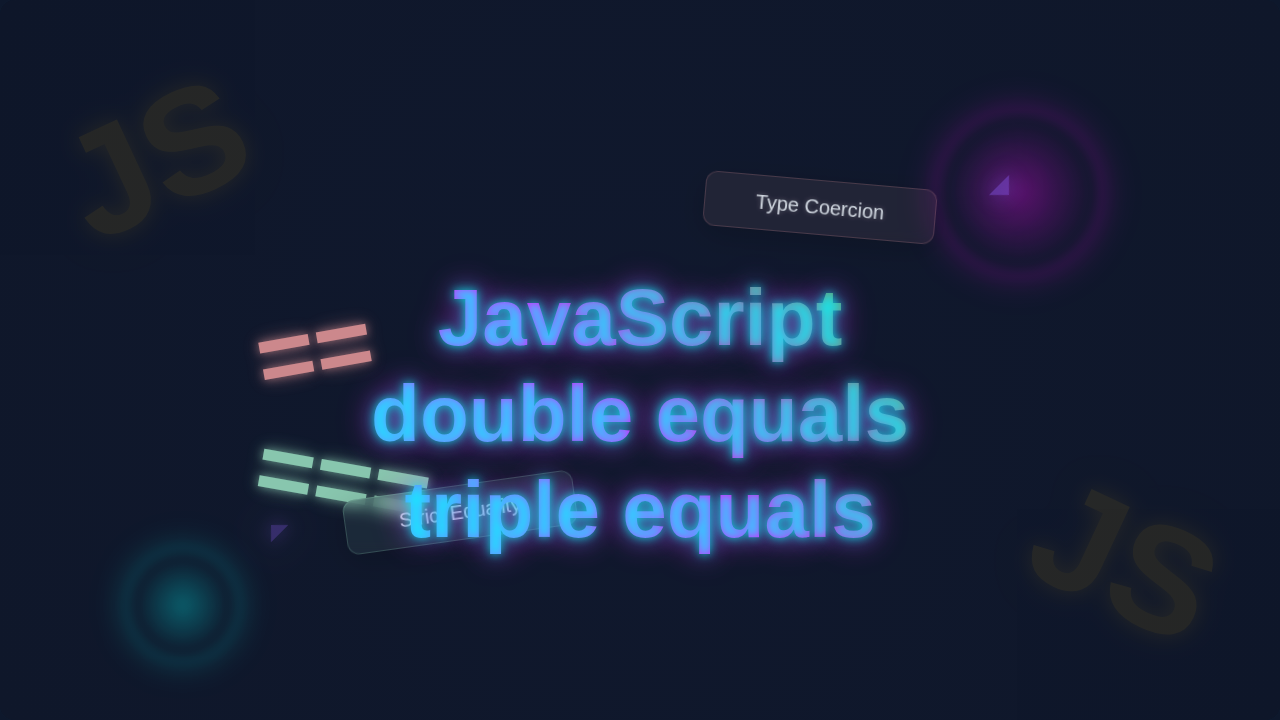
Hello there, future coding rockstar! If you are just starting your journey into web development, you’ve probably encountered a lot of new symbols. You might have even seen two very similar-looking operators in JavaScript: == and ===. These are the famous double equals and triple equals operators. If you are brand new to this topic, you might be wondering. Why does JavaScript need two ways to check if things are “equal”? You are not alone in this confusion!
Today, we’re going to uncover the truth about JavaScript double equals triple equals. We’ll explore what each one does. We will also learn why understanding them is super important for writing reliable code. Don’t worry if it seems tricky now. By the end of this post, you’ll have a clear picture of how they work. You’ll also know when to use each one confidently.
The Core Idea: What Even Is Equality in JavaScript?
Before we dive into the nitty-gritty, let’s talk about what “equality” means in programming. When you ask if two things are equal, you are asking if they are the same. This applies whether you are comparing numbers, text, or even more complex data. In JavaScript, you often need to make decisions based on these comparisons. For example, “If the user’s password is correct, then let them log in.” Or “If the shopping cart is empty, show a ‘shop now’ message.”
JavaScript gives you tools to check these conditions. The main tools for equality are the == operator and the === operator. They both compare values. But here’s the kicker: they do it in slightly different ways. This difference is tiny but mighty. It can lead to unexpected behavior in your code if you are not careful. So, let’s break down each one.
Diving Deep: JavaScript Double Equals (==) — The “Loose” Friend
Let’s start with the double equals sign, ==. You can think of this operator as a very accommodating friend. When you use == to compare two values, JavaScript tries to be helpful. It might adjust one or both of the values before making the comparison. This process is called “type coercion.”
What is type coercion? It means JavaScript temporarily converts the data type of one value to match the other. Imagine you have a number, like 5, and a piece of text that looks like a number, like "5". If you compare them using ==, JavaScript sees they are different types. It will then try to make them the same type. It might convert the text "5" into the number 5. Then, it compares 5 to 5, which are indeed equal. So, the comparison would result in “true.”
This “loose” comparison can seem convenient sometimes. However, it can also lead to surprising results. For instance, if you compare 0 (the number zero) with false (the boolean value), == will say they are equal. This is because JavaScript converts false to 0. It sees them as matching numbers. Similarly, an empty string "" compared to 0 will also be considered equal by ==. This is because both are seen as “falsy” values. You’ll learn more about truthy and falsy values later!
Here’s a simple analogy. Imagine you have a red apple and a picture of a red apple. The double equals is like someone asking, “Are these ‘red apples’?” They might say yes, because even though one is real and one is a picture, they both represent a red apple. They are loosely similar in concept. But they are not the exact same thing physically.
Pro Tip for
==: Using==can introduce unexpected bugs. It’s often safer to be explicit about your comparisons. If you aren’t sure, it’s generally best to avoid==.
This loose behavior means you sometimes get true when you expected false. Or vice-versa! It makes your code harder to predict. That’s why many developers, including me, often recommend using the other operator instead. You want your code to be as clear and predictable as possible. Right?
Diving Deeper: JavaScript Triple Equals (===) — The “Strict” Judge
Now let’s talk about the triple equals sign, ===. This operator is like a strict judge. When you use === to compare two values, JavaScript is much pickier. It asks two questions. First, are the values the same? Second, are their data types exactly the same? Both questions must be answered with a “yes” for === to return “true.”
The key difference here is the complete lack of type coercion. JavaScript will not convert anything for you with ===. If you compare the number 5 with the text "5" using ===, JavaScript will immediately notice they are different types. One is a number, and the other is a string (text). So, even though their values look similar, === will tell you they are not equal. It will return “false.”
Think back to our analogy. You have a red apple and a picture of a red apple. If the triple equals is asking, “Are these the exact same thing?” it would say no. One is a real, tangible fruit. The other is a flat image. They might represent the same concept, but they are not identical. This strictness is usually a good thing in programming.
Comparing 0 and false with === will result in false. Why? Because 0 is a number, and false is a boolean. Different types mean they are not strictly equal. Similarly, an empty string "" compared to 0 with === will also be false. This explicit check means fewer surprises for you as a developer. You always know exactly what you are comparing. This makes debugging much easier down the line.
Understanding the difference between JavaScript double equals triple equals is a foundational concept. It truly separates predictable code from code that might behave unexpectedly. Most of the time, you will want this strictness. It helps prevent subtle errors that are hard to track down. This is especially true when you are working with user input or data from external sources. You want to be sure you are comparing apples to apples, not apples to pictures of apples!
Golden Rule for
===: Always prefer using===unless you have a very specific reason and complete understanding of why==is necessary. It leads to more predictable and robust code.
Why Does It Matter? Real-World Scenarios
You might be thinking, “Okay, I get the difference. But how often will this really affect my code?” The answer is: more often than you think! Imagine you are building a registration form. You might want to check if a user’s input for an age field is a number. If they type “25” (a string) but your database expects 25 (a number), using == might make you think they are the same. But subtle issues could arise later. For a deeper dive into forms, check out our guide on React User Registration Form with JSX.
Another common scenario involves checking for the absence of a value. In JavaScript, null and undefined are two distinct values. They both mean “no value” but in different contexts. null == undefined will return true. But null === undefined will return false. If you are specifically checking for null, using === ensures you get exactly null, not undefined or anything else that loosely coerces to it. This precision is vital for certain operations.
So, when should you ever use ==? Honestly, very rarely in modern JavaScript development. There are a few edge cases where it might be intentionally used for its coercion behavior. However, these situations are specific and require deep knowledge of type coercion rules. For beginners, and even experienced developers, sticking with === is the safest and most recommended practice. It makes your code explicit. It also makes your intentions clear to anyone reading your code, including your future self!
Prioritizing strict equality reduces unexpected behavior. This makes your applications more reliable. It also makes you a more confident developer. You won’t have to wonder why a comparison isn’t working as expected. You’ll know exactly why!
What to Learn Next: Beyond Basic Comparisons
Understanding == and === is a fantastic first step. You’ve tackled a crucial concept that trips up many beginners. But the world of JavaScript comparisons is vast! Here are a few things you might want to explore next to deepen your knowledge.
- Truthy and Falsy Values: We briefly mentioned these. In JavaScript, many values that are not strictly
trueorfalsecan still behave like them in a boolean context. For example,0, empty strings"",null,undefined, andNaN(Not a Number) are all “falsy.” Everything else is generally “truthy.” Learning about these helps you understand how conditions work beyond simple equality checks. - The
Object.is()Method: This is another way to compare values in JavaScript. It is even stricter than===in some specific scenarios, especially when dealing withNaNand-0versus+0. It’s not something you’ll use every day, but it’s good to know it exists for very precise comparisons. - Comparison Operators: Don’t forget about other comparison operators like
<(less than),>(greater than),<=(less than or equal to), and>=(greater than or equal to). These are just as important for controlling the flow of your programs. You might use these for things like pagination, or sorting data. For example, when fetching data from an API, you often need to compare values. Learn more about fetching data with our JavaScript Fetch API Tutorial: HTML, CSS, & Vanilla JS Guide.
Keep practicing these concepts. Try creating small comparisons yourself. See what results you get. This hands-on approach really helps solidify your understanding. The more you experiment, the clearer these ideas become. You are building a strong foundation, one concept at a time!
Resources to Keep You Going
Learning is a continuous journey. You’ve already done great by making it this far! Here are some excellent resources to help you continue mastering JavaScript equality and beyond:
- MDN Web Docs: Equality comparisons and sameness – The official documentation is always a fantastic place for in-depth technical details. You’ll find comprehensive explanations of all equality operators there.
-
MDN Web Docs:
typeofoperator – Understanding data types is crucial for strict equality. Thetypeofoperator helps you inspect the type of any value. This is incredibly useful for debugging your comparisons! - Your trusty search engine! Whenever you encounter a concept you don’t understand, a quick search often leads to helpful articles and tutorials.
Remember, every developer started exactly where you are. There are no silly questions in programming. Keep being curious. Keep experimenting. You are doing great!
You’ve just conquered a significant hurdle in JavaScript. Understanding JavaScript double equals triple equals is a badge of honor for any budding developer. This knowledge will serve you incredibly well as you build more complex applications. Keep pushing yourself. The more you learn, the more powerful your coding skills become. Soon, you’ll be tackling even bigger challenges, like understanding the nuances of React Server vs Client Components: Understanding the Differences. Your journey is just beginning, and you’re already on your way to becoming an amazing pro coder!