Hey there, fellow self-taught coder! Have you ever built a cool script, maybe to automate a repetitive task, only to find it’s just… dumb? You tweak one tiny thing, and it breaks. Or it works perfectly for one scenario, then fails spectacularly on another. It’s frustrating, right?
You’re not alone if you’ve wished your programs could think for themselves. Sometimes, your script needs more than just a list of instructions. It needs to adapt. It needs to learn. And that’s where the magic of AI comes in, specifically with something called an AI Agent.
Traditional programs are like a recipe. You follow steps exactly. If an ingredient is missing, or a step is out of order, the whole thing falls apart. They don’t have any common sense. They can’t make educated guesses.
Moreover, they don’t remember past interactions. They simply execute. This rigidity often leaves you wanting more. You want a program that understands its surroundings. You want a system that can make its own smart choices. So, you’re craving a bit of intelligence in your applications.
The Lightbulb Moment: Python AI Agents Explained
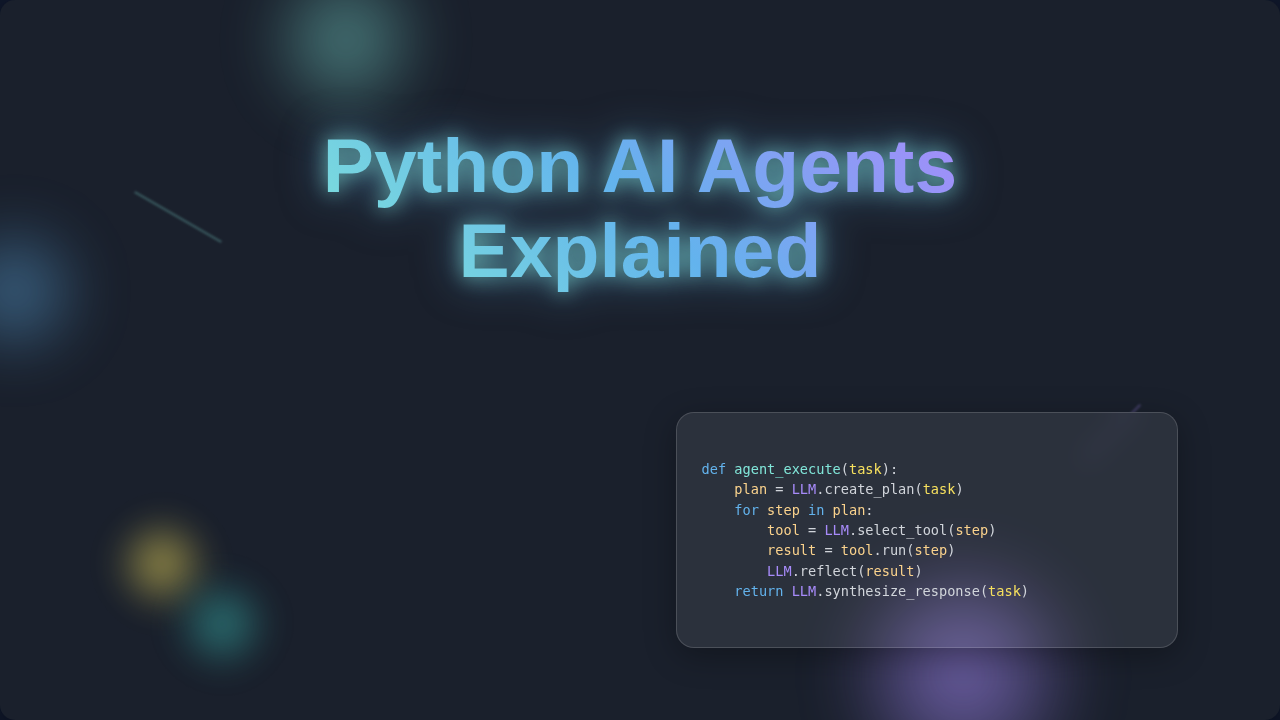
Then, you hear about AI Agents. And a lightbulb goes off! An AI agent is a program that perceives its environment, makes decisions, and takes actions to achieve a specific goal. Think of it as a smart, autonomous entity living inside your computer.
These agents are not just simple scripts. They have a degree of independence. They can react to changes. They can even learn from their experiences. This is where Python AI Agents Explained becomes super exciting.
An agent constantly observes. It gathers information from its surroundings. Then, it processes that information. It uses its internal logic to figure out what to do next. Finally, it acts upon that decision. The cycle then repeats. It’s a continuous loop of thinking and doing.
For example, imagine a script that just fetches today’s weather. That’s a program. An AI agent, however, might fetch the weather, decide if you need an umbrella, check your calendar for outdoor plans, and then send you a personalized warning. It doesn’t just report data; it uses it.
The difference is huge. One is a tool; the other is a helper. One is static; the other is dynamic. Understanding this distinction is your first big step. You’re moving from simple automation to genuine intelligent automation.
How to Think About Python AI Agents Explained
So, how do you even conceptualize one of these smart systems? Picture an AI agent like a tiny, digital assistant. This assistant has four main superpowers:
- Perception: It sees and hears its world. For a digital agent, this means reading data. It might scrape information from websites. It could listen for user input. Your agent collects all the necessary clues.
- Memory: It remembers things. This isn’t just short-term memory. It stores past experiences. It learns from those experiences. This helps it make better future decisions.
- Reasoning: It thinks about what it perceives and remembers. It uses rules or complex models to decide on the best course of action. This is the “brain” of your agent.
- Action: It does something. It might send an email. It could update a database. Perhaps it even makes a network call, like the kind you handle with the Python Requests Library: A Visual Guide. Your agent acts on its decisions.
Consider a smart thermostat as an analogy. It perceives the room temperature. It remembers your preferred schedule. It reasons about when to turn on the heat. Then, it takes the action of adjusting the furnace. It does this automatically.
That’s an agent! It’s constantly observing and acting. Furthermore, it’s trying to achieve a goal: keeping you comfortable. Therefore, when you think about building your own Python AI Agents Explained, you’re building systems with these core capabilities.
“Think of your AI agent as a digital detective. It gathers clues (perception), consults its case files (memory), connects the dots (reasoning), and finally, makes its move (action).”
The beauty of this model is its flexibility. You design each component. You teach your agent how to “see” and “think.” You give it purpose. Sounds powerful, doesn’t it?
Building Your First Agent: Python’s Role
Now, why is Python the go-to language for building these incredible systems? Here’s the thing: Python is incredibly versatile. It’s easy to read, which means you can focus more on the logic. You spend less time wrestling with complex syntax.
Furthermore, Python has an enormous ecosystem of libraries. For perception, you might use tools that fetch data from the web. For reasoning, you have access to powerful machine learning frameworks. These libraries handle much of the heavy lifting for you.
You simply describe what you want to achieve. Python helps you piece together the components. It’s like having a giant toolbox for every possible AI task. You don’t need to build everything from scratch.
Imagine building a personal shopping agent. It perceives prices across different online stores. It remembers your past purchases and preferences. It reasons about the best deal. Then, it takes action by alerting you, or even placing an order. This entire process relies on the agent’s ability to interact with web services. Understanding how web communication works is key here.
Consider another unique idea: an agent that helps you manage your digital subscriptions. It scans your email for new subscriptions. It analyzes your usage patterns. Perhaps it even suggests which services you might cancel to save money. This requires parsing various data formats. Knowing about structured data formats like JSON is very helpful.
Python’s clear syntax lets you focus on the agent’s brain. You define its goals. You teach it how to make decisions. The language just gets out of your way. This makes it perfect for beginners and seasoned pros alike.
What to Do Next: Practical Steps for Python AI Agents
Feeling inspired? That’s great! The best way to learn is by doing. You can start small. Don’t try to build the next Skynet on your first try. Begin with a straightforward problem.
Perhaps you want an agent that monitors a specific news feed. It could identify articles on a topic you care about. Then, it summarizes them for you. This covers perception, basic reasoning, and action.
Focus on one component at a time. First, practice making your agent “perceive” its environment. Learn how to gather relevant data. Then, work on its “memory.” How will it store past observations? Later, tackle the “reasoning” part. This might involve simple if-then rules initially. Gradually, you can explore more complex decision-making models. Finally, allow it to “act.”
“Start simple, but think big. Your first AI agent might just sort emails, but that’s the foundation for truly autonomous systems.”
There are many beginner-friendly resources available. Look for tutorials on Python libraries for data processing and simple decision logic. You’ll find that the concepts are more accessible than they sound. Take your time. Experiment. You’ll see your ideas come to life.
Wrapping Up Your AI Agent Journey
So, you’ve seen what AI agents are. You understand their core components. Most importantly, you know why Python is your best friend for building them. You’re no longer just writing programs. You’re crafting intelligent entities.
These agents can learn. They can adapt. They can solve complex problems autonomously. This is a game-changer for many applications. From automating your daily tasks to creating sophisticated smart systems, the possibilities are endless.
Don’t worry if it feels like a lot to take in right now. The journey of a thousand lines of code begins with a single step. You have the tools. You have the understanding. Now, it’s time to build.
Keep experimenting. Keep learning. Your next project could be your very own smart agent. What incredible problem will you empower your Python AI agent to solve?