Hey there, future coding rockstar! Have you ever stumbled upon the term ‘JavaScript closures’ and felt like you just hit a secret, mythical boss in your coding journey? Maybe it sounded like something super advanced, or perhaps a bit confusing. Don’t worry, you are absolutely not alone. Today, we are going to shine a bright, neon spotlight on this core JavaScript concept. By the end, you will not only get it, but you will also understand why it is so incredibly useful.
What JavaScript Closures Are, in Plain English
So, what exactly are JavaScript closures? Imagine you have a special backpack. You pack this backpack with all your favorite snacks and a water bottle. Then, you head out on a hike. Even when you are deep in the woods, far from your kitchen, you still have access to everything inside your backpack, right? That is kind of like a closure.
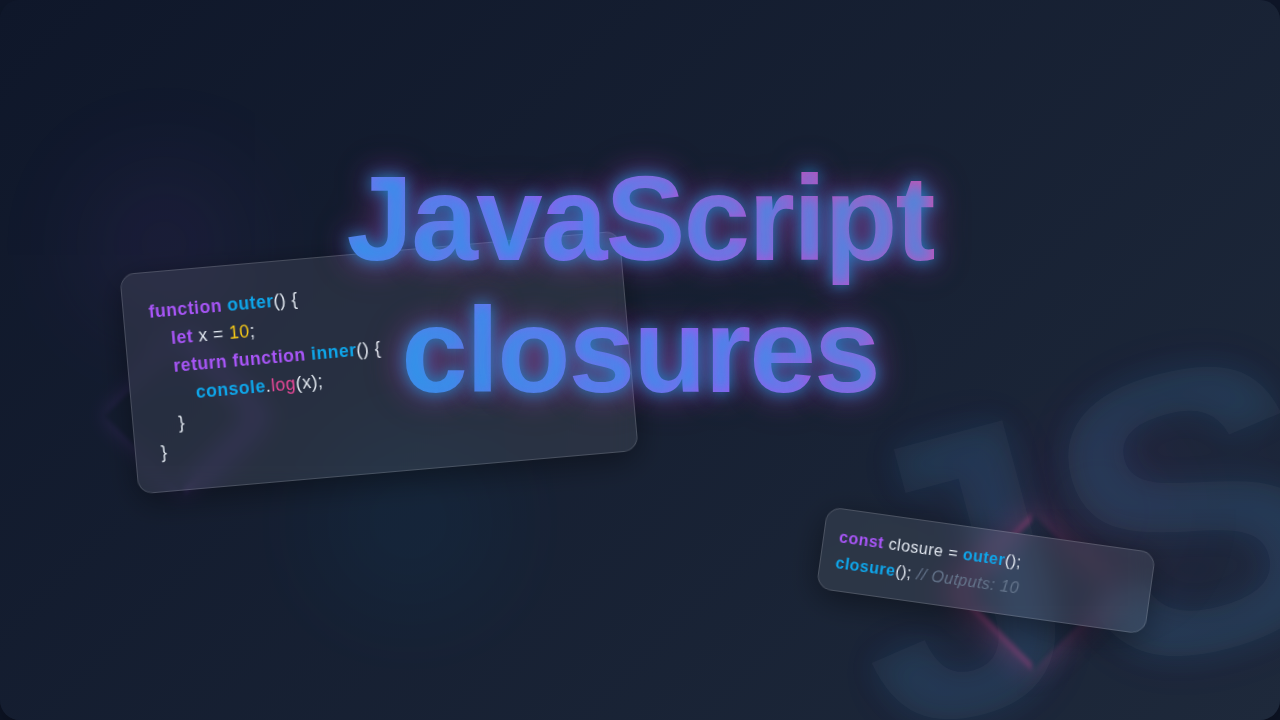
In plain English, a JavaScript closure happens when an inner function remembers and accesses its outer function’s variables, even after that outer function has finished executing. It forms a persistent connection. This means the inner function “closes over” the environment it was created in. It keeps that data alive and accessible. Think of it as a function that carries a little piece of its birthplace with it, wherever it goes.
Why JavaScript Closures Matter to YOU
You might be thinking, ‘Okay, cool, but why should I care about JavaScript closures?’ Here is the thing: understanding closures unlocks a whole new level of power in your JavaScript code. You will start seeing them everywhere once you know what to look for. They are not just some academic concept; they are foundational to many patterns you already use or will soon use.
For instance, they are behind powerful techniques like module patterns. They enable data privacy, letting you create functions that have ‘private’ variables. This means you can hide certain data from the global scope. This keeps your code clean and prevents accidental changes. You can also use them for creating specialized functions, like a counter that remembers its current count. Or perhaps a memoization technique to boost performance by remembering calculation results. Basically, they help you write more robust, efficient, and organized code.
Furthermore, closures are invaluable for creating higher-order functions. These are functions that either take other functions as arguments or return functions. Many utility libraries and modern JavaScript patterns leverage this heavily. You might use a closure to ‘curry’ a function, transforming it into a sequence of functions that each take one argument. This makes your code more flexible and reusable. You can easily adapt functions to various situations without rewriting them entirely. They are also central to the way many popular frameworks manage component state, offering a robust way to isolate and control data flow. You can explore more about JavaScript module patterns on CSS-Tricks, where closures play a key role. They are a secret weapon for managing state and building powerful components, much like how you would manage state in a complex React CRUD App Tutorial: Build a Full CRUD Application with JSX.
How JavaScript Closures Actually Work
Let us peel back the layers and see the magic of JavaScript closures in action. It all starts with nested functions. You create a function, and inside it, you define another function.
Imagine you have a master chef function, let us call it prepareSandwich. Inside prepareSandwich, you have an ingredient list variable, perhaps breadType. Now, inside prepareSandwich, you define another function, addFilling. This addFilling function needs to know the breadType.
When prepareSandwich runs, it creates breadType and then returns the addFilling function. Crucially, it does NOT execute addFilling right away. It just hands it over.
Here is the amazing part: even after prepareSandwich has finished its job and disappeared from the call stack, the addFilling function still ‘remembers’ the breadType it was born with. It keeps a live link to that specific breadType variable. It carries that piece of information with it, like a special passkey.
This specific instance of breadType is not just floating away when prepareSandwich finishes. Because addFilling (the inner function) was created within prepareSandwich and remembers breadType, that variable stays alive in memory. It forms a kind of persistent connection, or a ‘baggage tag,’ for addFilling. When JavaScript sees that an inner function needs a variable from its parent’s scope, it ensures that variable sticks around. It is like the addFilling function has a secret vault where it keeps breadType safe and sound. So, when you later call addFilling, it can still access and use breadType. That is the closure! The inner function, addFilling, closes over the variable breadType from its outer environment. This concept is deeply tied to JavaScript’s lexical scoping, which determines how variables are resolved. If you are keen for a really Deep Dive into Scope & Memory, that post explores these underlying mechanics further. You can also dive deeper into function scope on MDN if you are curious. This robust mechanism is what makes functional programming paradigms in JavaScript so powerful.
Pro Tip: A function always remembers the environment where it was created, not where it was called. This is the core principle of closures!
Common Confusions Cleared Up
It is perfectly normal for closures to feel a bit tricky at first. Many beginners hit a few snags. Let us tackle some common sticking points you might encounter.
First, people sometimes confuse closures with global variables. With a global variable, any part of your code can access and change it. This often leads to unexpected bugs. Closures, on the other hand, provide a contained environment. Only the inner function (and functions returned from it) can access the ‘closed-over’ variables. This offers much better control and prevents interference.
Another confusion arises with loops. You might try to create multiple functions inside a loop, expecting each to remember a unique value from that loop iteration. However, without a closure, they often all remember the last value of the loop variable. The trick is to create a new scope for each iteration. This forces each function to ‘close over’ its own unique set of variables.
Think of it like giving each student in a class their own personalized locker (a closure) versus one giant communal shelf (a global variable). With the locker, their items are safe and distinct. With the shelf, everyone’s items get mixed up.
Another area where closures might pop up unexpectedly is with asynchronous operations. Think about setTimeout or fetching data. You set up a function to run later, after some delay or when data arrives. Often, this function needs to access variables that were present when it was scheduled. Closures ensure these variables are still available when your function finally executes. They capture the state at the time of creation, preserving it for later use. This is crucial for handling events and network requests without losing context. It means your event handler, for example, will always have access to the specific data it needs, even if the surrounding code has moved on. It is a subtle but powerful aspect of JavaScript’s non-blocking nature.
Memory Management Insight: Variables captured by a closure stay in memory as long as the closure itself exists. This is why they are great for persistent state, but be mindful of unintentionally holding onto large objects.
Consider this too: when you are building a React Password Strength Indicator with Hooks Tutorial, you often use useState and useEffect. These React Hooks heavily rely on closure principles under the hood to manage state and side effects effectively, ensuring that your component’s functions always have access to the correct state values from their render cycle.
Key Takeaways
Alright, let us quickly recap what we have covered. You are almost a closure master!
- What they are: A closure means an inner function remembers and can access variables from its outer (parent) function, even after the outer function has finished running.
- Why they matter: They are super powerful for data privacy, creating specialized functions, and building robust modules.
- How they work: It is all about the function remembering its birth environment – the scope where it was defined.
This concept is everywhere in modern JavaScript frameworks. For example, when you work with event listeners, asynchronous code, or module patterns, you are likely interacting with closures. They allow you to create powerful, flexible, and maintainable code. They are not just an abstract idea; they are a fundamental tool in your web development toolkit.
See? Not so mythical after all! JavaScript closures are a cornerstone of effective JavaScript programming. You just demystified a concept that confuses many seasoned developers. Give yourself a pat on the back!
The best way to truly grasp them is by experimenting. Try creating some nested functions. See what happens when you return an inner function and call it later. Play around with different scenarios. You will find that with a little practice, this powerful concept becomes second nature. Keep building, keep learning, and keep asking questions. You are doing great, and your coding journey is just getting more exciting!