Node.js Isn’t Single-Threaded: How libuv and the OS Kernel Actually Run Your Code
Hey there, fellow dev! You’ve probably heard the saying: Node.js is single-threaded. Maybe you even repeated it yourself. But here’s the thing – that idea is one of the biggest myths in web development. It’s like saying a chef only uses one knife when they have a whole kitchen crew. Today, we’re going to bust the Node.js single threaded myth wide open.
For a long time, understanding how Node.js works internally felt like trying to decipher an alien language. You hear terms like ‘event loop’ and ‘asynchronous,’ and your brain just goes into overload. Many beginners mistakenly believe Node.js runs everything on a single lane, which seems impossible for real-world applications. After all, how can one thread handle tons of users and complex tasks at once?
This misconception often leads to confusion about performance and scalability. You might think, ‘If it’s single-threaded, won’t my app freeze during a long database query?’ That’s a great question! The truth is much more nuanced and powerful. Node.js leverages some clever engineering to keep things moving. We will explore how libuv explained helps with this, working with the operating system to perform heavy lifting. This setup is crucial for the Node.js event loop to shine, ensuring your applications remain responsive.
Understanding the Node.js Single Threaded Myth and How Node.js Works Internally
1. The JavaScript Engine: V8’s Single Thread
First up, let’s talk about the core: the V8 engine. This is Google’s open-source JavaScript engine. It’s what takes your JavaScript code and turns it into super-fast machine code that your computer understands. V8 itself is single-threaded. This means it can only execute one piece of your JavaScript code at any given moment. Think of it like a meticulous artist painting a canvas – they can only make one brush stroke at a time, even if they have many colors available.
So, when you write a simple for loop in Node.js, V8 handles that. It processes each iteration sequentially. This is why long-running, CPU-intensive JavaScript code will indeed block the main thread. Your Node.js application will feel frozen until that specific JavaScript task finishes. But here’s where the magic starts to unfold, preventing your entire application from grinding to a halt.
libuv Explained: Node.js’s Secret Weapon for Async Tasks
2. Enter libuv: The Multi-threaded Orchestra Conductor
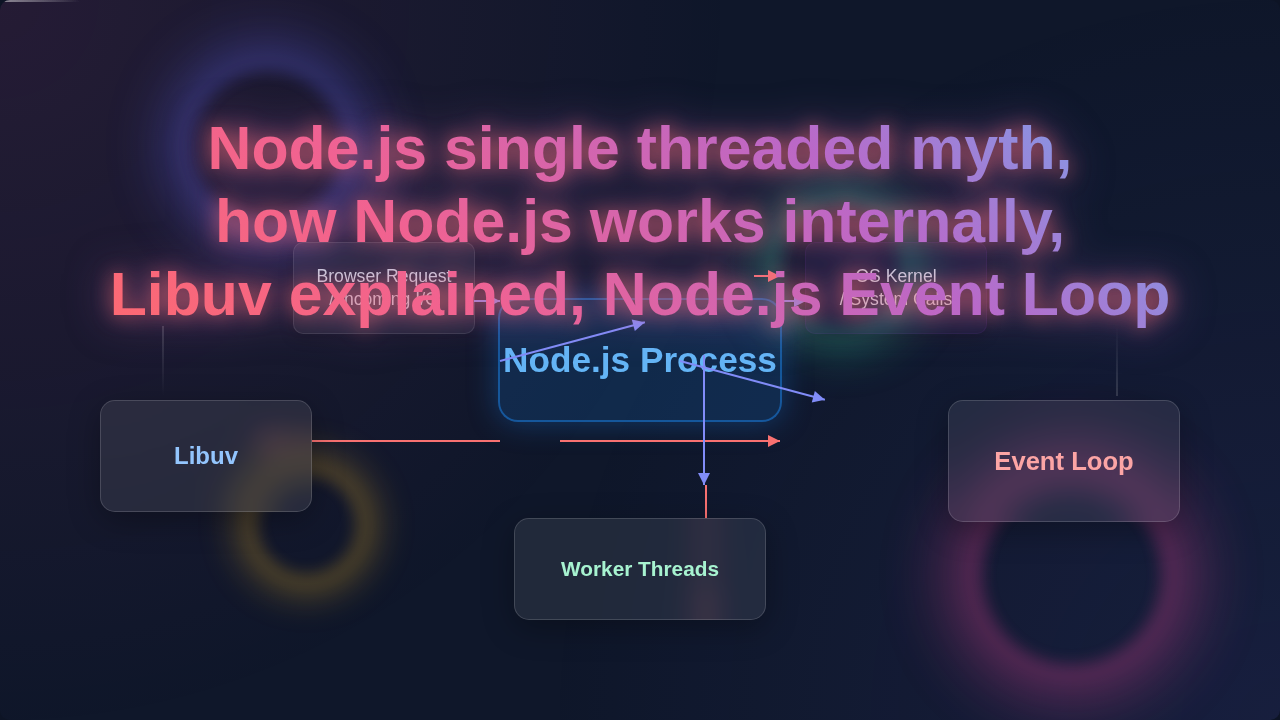
Okay, so V8 is single-threaded. But what about all those heavy tasks? Like reading files, making network requests, or talking to a database? This is where libuv comes into play. libuv explained: it’s an open-source C library that provides asynchronous I/O capabilities. Think of libuv as Node.js’s brilliant assistant manager. It doesn’t run your JavaScript, but it takes all those non-JavaScript, time-consuming operations off V8’s plate.
When your JavaScript needs to do something slow, like fetching data from a remote server, libuv steps in. It takes that task and delegates it. This delegation is key to the overall performance. It essentially says, ‘Hey, V8, you keep running JavaScript. I’ll handle this waiting game for you.’ This division of labor is why Node.js can be so efficient, even with a single main JavaScript thread. It’s not just one person doing everything; it’s a well-coordinated team.
The Thread Pool: Your Async Workhorses
3. The Thread Pool: Your Async Workhorses
Now, how does libuv actually perform those delegated tasks? It uses a thread pool. A thread pool is a group of pre-initialized worker threads. Think of these threads as a team of dedicated workers waiting for instructions. When libuv gets a task that would normally block the main JavaScript thread – say, reading a large file from your hard drive – it hands that task to one of these available threads in its pool.
These worker threads then execute the blocking operation in the background. Your main JavaScript thread, meanwhile, remains free. It keeps processing other incoming requests or executing more JavaScript. Once a worker thread finishes its assigned job, it sends the result back to libuv. This makes sure that your Node.js application doesn’t get stuck waiting. It’s like having a separate crew in the kitchen preparing ingredients while the head chef focuses on plating dishes. You can explore how similar patterns are used to mastering HTTP in Python, where blocking network calls are also common.
Node.js might have a single JavaScript thread, but libuv’s thread pool gives it a multi-threaded superpower for those heavy-lifting operations.
The Node.js Event Loop: Always Listening, Always Moving
4. The Node.js Event Loop: Always Listening, Always Moving
So, how do all these pieces communicate? That’s the job of the Node.js event loop. The event loop explained: it’s a constantly running process that checks if the call stack is empty and if there are any pending tasks in the callback queue. Imagine the event loop as a meticulous supervisor at a factory. It constantly watches the main assembly line (the V8 engine) and the incoming task queue.
When a background task (handled by libuv and its thread pool) completes, it places a ‘callback’ function into a queue. The event loop then monitors this queue. As soon as the main JavaScript thread becomes idle, the event loop picks up the next callback from the queue. It then pushes that callback onto the call stack for V8 to execute. This mechanism ensures that your application stays non-blocking. It’s what allows Node.js to handle many concurrent operations efficiently. Ever wondered how real-time messaging applications stay so responsive? The event loop is a big part of that magic.
The Node.js event loop isn’t just a concept; it’s the dynamic conductor ensuring your async tasks gracefully rejoin the main thread.
Non-Blocking I/O: Why Your App Stays Zippy
5. Non-Blocking I/O: Why Your App Stays Zippy
This whole architecture leads to Node.js’s strength: non-blocking I/O. I/O stands for Input/Output operations. These are things like reading from a file, writing to a database, or making a web request. In traditional blocking models, your entire program would pause and wait for these operations to finish. But with Node.js, that doesn’t happen.
Thanks to libuv and the event loop, these I/O operations are handled asynchronously. When you request data, Node.js tells the operating system (through libuv) to start the task. It then immediately moves on to the next piece of JavaScript. The OS notifies Node.js when the data is ready. This is like ordering food at a busy diner. You place your order, then go chat with friends. You don’t stand at the counter staring at the chef! The waiter (libuv) will bring your food when it’s ready. This allows Node.js to process many requests simultaneously without slowing down.
The OS Kernel: The Unseen Powerhouse
6. The OS Kernel: The Unseen Powerhouse
Behind libuv and its thread pool, there’s another crucial player: the operating system kernel. The OS kernel is the core of your computer’s operating system. It manages your computer’s resources, like memory, CPU, and connected devices. When libuv delegates a task, especially I/O operations, it’s often communicating directly with the OS kernel. The kernel is actually the one performing the heavy lifting for many native asynchronous operations.
For example, when Node.js needs to read a file, libuv tells the OS kernel to do it. The kernel has highly optimized routines for these tasks. It can perform file system operations or network requests far more efficiently than any user-space library could on its own. It’s the ultimate background worker, handling tasks at the deepest level. This direct communication with the kernel is a huge reason why Node.js is so performant for I/O-bound tasks. You could say it’s why your JavaScript applications feel so fast when handling lots of data.
Bonus Tip: Embrace Asynchronicity
Now that you understand how Node.js works internally, you can see why embracing its asynchronous nature is vital. You, as the developer, need to write your JavaScript code with this in mind. Using async/await or callbacks is not just a style choice. It’s how you leverage Node.js’s full power. Think about designing a responsive product card UI. You wouldn’t expect all images to load instantly, blocking the entire page. Instead, you load them as they become available. That’s the asynchronous mindset.
Avoid long-running, synchronous CPU-bound tasks in your main JavaScript code. If you absolutely need to perform heavy calculations, consider offloading them to Web Workers (in the browser) or child processes in Node.js. This keeps the event loop free and your application snappy. Learning about Web Workers in JavaScript can open up new possibilities for truly multi-threaded operations outside the main thread.
Quick Summary
So, is Node.js single-threaded? Yes, for your JavaScript code on the main thread, the Node.js single threaded myth holds a kernel of truth. But it’s far from the whole story! You now know that Node.js works internally as a sophisticated system. It combines the single-threaded V8 engine with the powerful, multi-threaded capabilities of libuv explained, leveraging the operating system kernel. This partnership is orchestrated by the brilliant Node.js event loop.
This architecture is what allows Node.js to be so incredibly efficient for I/O-bound applications. You can confidently build scalable, high-performance web services. Keep these internals in mind as you code. They will help you write better, more performant Node.js applications. You’ve got this!