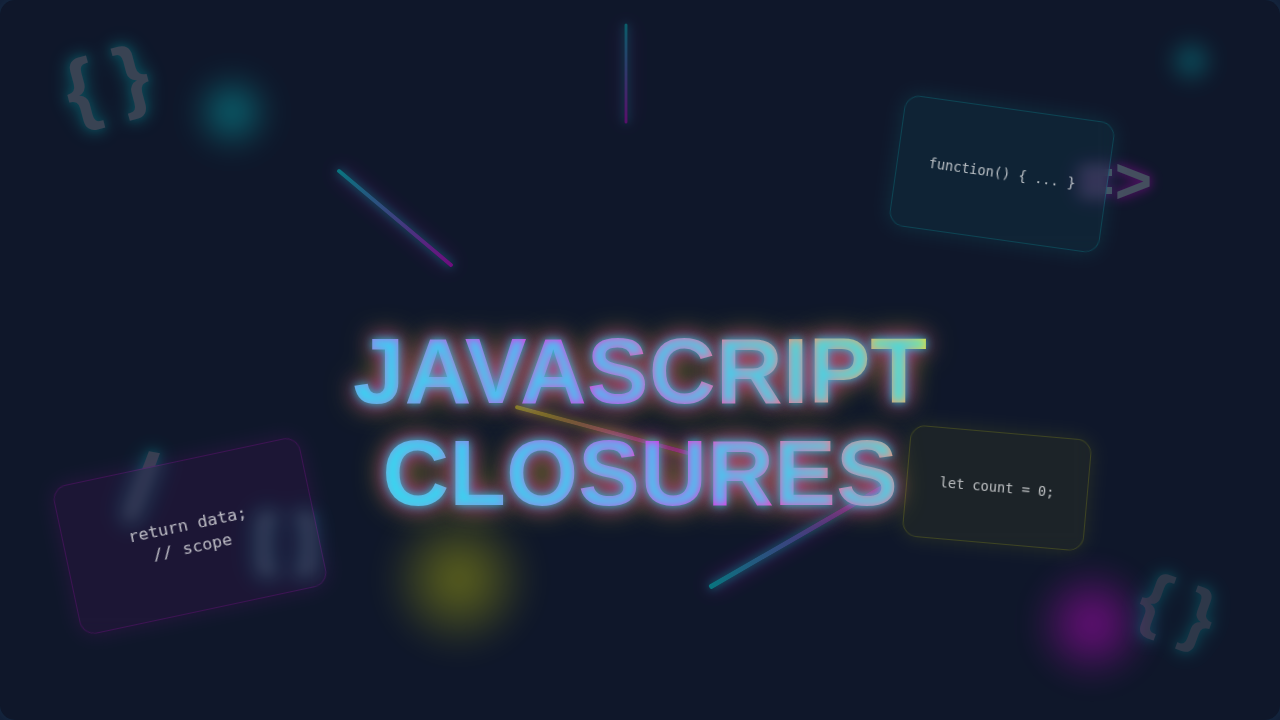
JavaScript Closures Unveiled: Abstract Neon Code Guide
Hey there, future JavaScript wizard! Have you ever felt like some programming concepts just whisper secrets you can’t quite catch? Like “JavaScript Closures” perhaps? Don’t worry, you are definitely not alone. When I first encountered them, they felt like magic. But soon, they became one of my favorite tools.
Today, you and I are going to pull back the curtain on these powerful beasts. We’ll demystify what JavaScript Closures truly are in simple terms. Then, you’ll see why they’re not just a fancy academic concept. They are a practical superpower for your code. Ready to make some magic of your own?
What Exactly Are JavaScript Closures, Anyway?
Let’s start with a friendly analogy. Imagine you’re baking a cake. You have your recipe, your ingredients, and your kitchen. Now, let’s say your kitchen is a function. Inside your kitchen, you start mixing ingredients.
A closure happens when an inner function, like preparing the frosting, remembers and has access to its outer function’s ‘kitchen’s’ ingredients. This access happens even after the main cake-baking (outer function) is totally finished. It’s like the frosting function has a permanent shopping list of what was available in the kitchen when it was created. It can always grab those specific items.
So, in plain JavaScript terms: A closure is the combination of a function and the lexical environment within which that function was declared. This means an inner function remembers variables from its outer scope. It remembers them even when the outer function has already finished executing. Make sense so far?
This is a fundamental concept for understanding how JavaScript works. It powers many advanced patterns you’ll encounter. You might not even realize you’ve used them before!
Pro Tip: Think of a closure as a function carrying a backpack of memories from where it was born. Those memories are the variables it has access to!
Why Do JavaScript Closures Matter to You?
You might be thinking, “Okay, that sounds cool, but why should I care?” The truth is, closures are everywhere in modern JavaScript development. You probably use them without even knowing it! They are a cornerstone for many powerful features. Understanding them lets you write cleaner, more efficient, and more robust code.
Here’s why they’re super important for you:
First, they help with data privacy and encapsulation. You can create private variables that only specific functions can modify. This is like having a private vault within your code. Only authorized personnel (your inner functions) can access its contents. This protects your data from accidental changes. It keeps your code organized.
Second, closures enable functional programming patterns. You can create factory functions that generate other functions. Each generated function remembers its unique setup. This is incredibly useful for creating custom, reusable components. For example, you might create a function that makes ‘incrementer’ functions. Each incrementer function could start at a different number. Pretty neat, right?
Third, they are essential for asynchronous operations. Think about callbacks or event handlers. They often need to access variables from their surrounding environment. Closures ensure that these variables are available. Even if the original function has long completed its task. This is crucial for things like network requests or UI interactions.
Finally, they play a huge role in popular libraries and frameworks. If you’ve ever used React’s useEffect hook, you’ve indirectly experienced the power of closures. Understanding them helps you debug and optimize your applications more effectively. You’ll gain a much deeper insight into how things work under the hood.
Demystifying JavaScript Closures: How They Actually Work
Let’s dive a little deeper into the mechanics. No need for complex code examples, just a simple mental model. Every time you define a function in JavaScript, it forms a closure. This function remembers the environment where it was created. This environment includes all the local variables and parameters of its outer function.
Consider a scenario where you have an outer function that defines a variable. Inside this outer function, you define another inner function. This inner function then uses the variable from its parent. When the outer function finishes executing, its ‘execution context’ might disappear. However, the inner function still holds a reference to that specific variable. This is the magic of closures.
The inner function keeps a ‘link’ to the outer function’s variable scope. This link is called the ‘scope chain’. Even when the outer function is no longer running, the inner function can still access and even modify those variables. It’s like leaving a door open to a room. You can still go back in later.
Imagine a vending machine that makes personalized keychains. You tell the machine your name (this is the outer function). The machine then generates a tiny robot (the inner function). This robot’s sole job is to print your name onto a keychain. Even if you walk away (the outer function finishes), that robot *remembers your name*. It keeps printing keychains with *your* name. That’s a closure in action! The robot (inner function) closes over your name (outer function’s variable).
This principle is what allows you to create private counters or manage state in advanced React forms. You are essentially creating a protected scope for certain variables. This makes your code more predictable and less prone to side effects.
Common JavaScript Closures Confusions Cleared Up
It’s easy to get a bit tangled up with closures. Let’s tackle some common sticking points you might encounter:
Confusion 1: “Closures are just private variables.” While closures *enable* private variables, they are more fundamental. A closure is about a function’s memory of its creation environment. Private variables are a *result* of this memory. You can use closures for much more than just privacy, like creating function factories or memoization. They are a broad concept, not just a specific pattern.
Confusion 2: “Variables are copied into the closure.” No, not exactly. The inner function doesn’t get a *copy* of the variables. It gets a *reference* to them. This means if the outer function’s variable changes *before* the inner function is called, the inner function will see the updated value. It’s like having a shared whiteboard. Both functions look at the same writing. If one changes it, the other sees the change.
Confusion 3: “Every nested function is a closure.” Yes, technically, every time you define a function inside another, it forms a closure. The key is when that inner function is *returned* or *passed somewhere else*. That’s when its ability to remember its outer scope truly shines. If it’s just executed immediately and its parent scope is gone, the effect isn’t as apparent. It’s about persistence.
Understanding these nuances will really solidify your grasp of closures. Don’t worry if it doesn’t click instantly. Keep experimenting and thinking through the examples. It clicks eventually.
Remember: Closures are not about *what* is inside the function, but *where* the function was created and *what it remembers* from that place.
Key Takeaways on JavaScript Closures
So, you’ve journeyed through the abstract neon code guide of JavaScript Closures. What should you absolutely remember from our coffee chat?
- A closure is a function bundled with its surrounding state (lexical environment).
- It lets an inner function access its outer function’s variables. This happens even after the outer function has finished executing.
- Closures are crucial for data privacy, creating factory functions, and managing asynchronous operations.
- They don’t copy variables; they maintain a reference to them.
- You encounter them constantly in modern JavaScript, often without realizing it.
This understanding will help you write more sophisticated and maintainable JavaScript. It’s a foundational piece of the language puzzle. Knowing this concept deeply helps you understand many others, like advanced function patterns.
Go Forth and Close Some Scopes!
You’ve taken a big step today! Understanding JavaScript closures is a significant milestone for any self-taught developer. It shows you’re ready to dig deeper into how JavaScript truly works. Don’t be intimidated by complex-sounding terms.
The most important thing is to keep experimenting. Try to identify closures in code you already write or read. See how they interact with different scenarios. The more you play with them, the more natural they’ll feel.
You’ve got this. Keep building, keep learning, and keep asking questions. Your journey to becoming a JavaScript master is well underway!