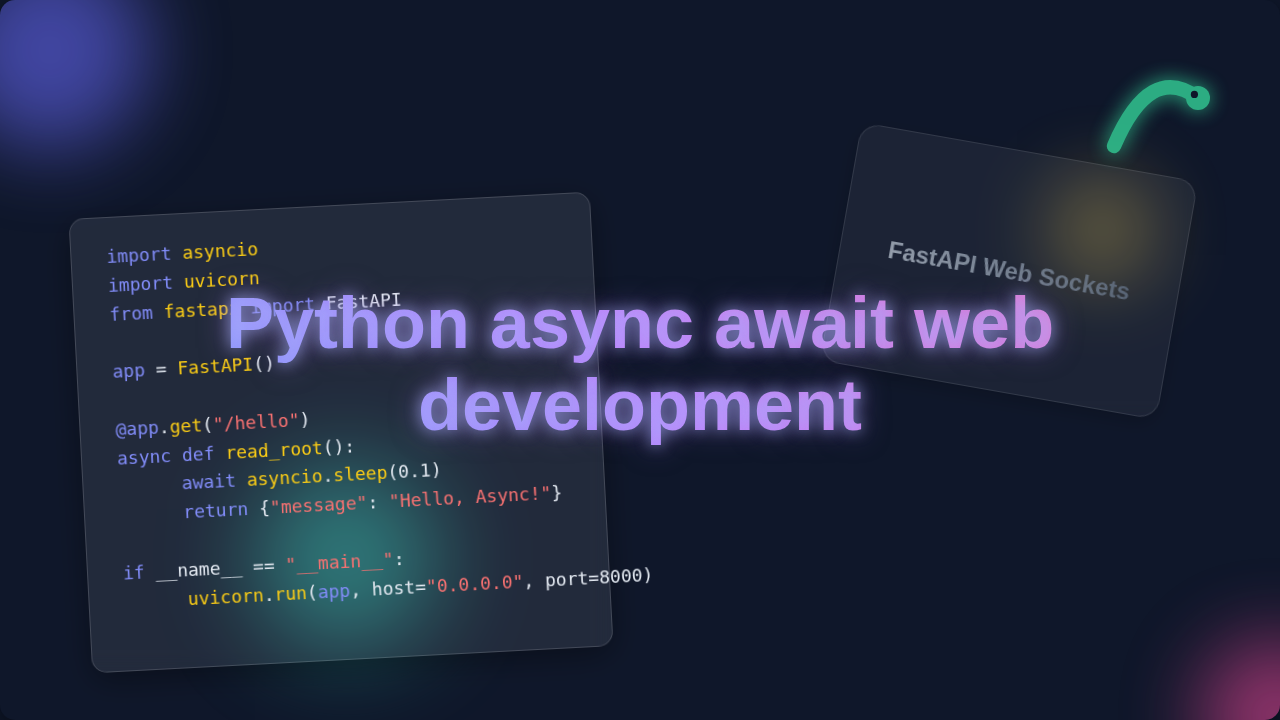
Python Async Await Web Dev: Build Fast, Modern APIs
Hey there, fellow coder! Ever felt like your web app was waiting around, twiddling its thumbs, while a slow request finished? You’re not alone. It’s a common bottleneck. This is where the magic of Python async await web development comes into play.
Many developers, just like you, encounter this. They wonder how to make their applications snappier. Today, we’re going to demystify async/await. You’ll soon understand how it helps you build incredibly fast, modern APIs.
What is Asynchronous Python? A Quick Chat
Imagine you’re at a coffee shop. In a "synchronous" world, you’d order your coffee. Then, you’d stand still, waiting, until your exact coffee is ready. Only then could you order a pastry. You complete one task fully before starting the next.
Now, think "asynchronous." You order your coffee. While the barista is making it, you immediately step aside. You then browse the pastry selection. Perhaps you even start paying. You’re doing multiple things concurrently, not strictly one after another. Your time is used much more efficiently.
In Python, asynchronous programming means your program doesn’t halt. It doesn’t block. It doesn’t wait for one long operation to finish completely. Instead, it can pause that operation. Then, it moves on to another task. It returns to the first task once it’s ready to continue. This is managed by something called an "event loop." This loop is like a master conductor. It decides which tasks run when.
Why Python Async Await Matters for Your Web Development
So, why should you care about this? Here’s the thing: most web applications spend a lot of time waiting. They wait for databases. They wait for external APIs. They wait for network requests. For example, when your backend makes a request using a library like the Python Requests Library explained in this visual guide, it’s often waiting for data to come back.
This "waiting" time is prime real estate for improvement. In a traditional synchronous setup, your server might handle one user’s request. It then waits for a database query to finish. During that wait, it cannot serve another user. It’s stuck.
With async/await, your server can say, "Okay, I’m waiting for the database for User A. Meanwhile, I’ll go process User B’s request." This means your application can handle many more users. It stays responsive under heavy load. This is huge for modern APIs. You get better performance. You get happier users. It’s a game-changer for scalability.
Furthermore, if you’re doing something like Python web scraping to extract data, imagine fetching many pages at once. Async makes that incredibly fast. You launch multiple fetches. You wait for them all to complete as they become ready.
How Async/Await Actually Works: The "Cooperative Multitasking" Dance
At its core, async/await in Python builds on special functions. These are called "coroutines." You define them using async def. When you call an async def function, it doesn’t run immediately. Instead, it returns a "coroutine object." Think of this as a blueprint for a task. It’s a task that *can* be run, but hasn’t yet.
The key keyword is await. When your program encounters an await keyword, it signals something important. It says, "Hey, I’m about to do something that might take a while. I’m going to ‘pause’ here. But don’t worry! I’ll let the event loop take over. It can run other tasks while I’m waiting." This is cooperative multitasking. Your code *cooperates* with the event loop. It explicitly gives up control.
Let’s use an analogy. Imagine you’re a chef preparing a complex meal. You put a pot of water on to boil (an I/O-bound task). You don’t just stare at the pot. Instead, you `await` the water to boil. While it’s boiling, you start chopping vegetables. You’re doing something else productive. When the water *does* boil, you return to it. You continue cooking your pasta. This is exactly how await works. It allows other "vegetable chopping" tasks to run while one task waits for an "I/O event."
Pro Tip: Think of
awaitas saying, "I’m stepping aside for a moment, but please call me back when this specific thing I’m waiting for is done." It makes your program efficient, not necessarily faster for single, compute-heavy tasks.
Navigating Common Confusions in Python Async Await Web Development
Okay, let’s clear up some common misunderstandings you might encounter. First, asynchronous Python is *not* the same as multi-threading or multi-processing. It doesn’t run tasks in true parallel. It’s about efficiently managing tasks on a single thread. It’s one thread doing many things by cleverly switching between them. This is especially true when tasks involve waiting.
Secondly, async/await won’t magically speed up CPU-bound tasks. If your code is crunching numbers non-stop, without waiting for anything external, async/await won’t help. It’s designed for I/O-bound operations. These are things like network requests, file access, or database queries. For CPU-bound tasks, you might still need multi-processing. Or you could consider learning about promises in JavaScript to see similar concepts for web browsers.
Another point: once you start using async, it often needs to propagate. If a function `await`s another `async` function, then the calling function usually needs to be `async` too. It creates an "async ecosystem." Your entire chain of dependent calls should ideally be asynchronous. This can be a shift if you’re used to frameworks like Flask, which are typically synchronous, as explored in our Flask Blog API Tutorial.
Key Insight: Async/await shines when your application is waiting for external resources, not when it’s performing intensive calculations. Use it strategically!
Key Takeaways for Your Web Development Journey
Let’s recap what we’ve covered. Asynchronous Python, with its async and await keywords, is a powerful tool. It helps your applications remain responsive. It does this by efficiently managing I/O-bound tasks. This means your web servers can handle more users. They can process more requests. This leads to faster, more robust APIs. Remember, it’s about cooperative multitasking. Your functions yield control when they wait. The event loop then steps in. It keeps other tasks moving.
Ready to Speed Up Your Python Apps?
Understanding Python async await web development might seem like a lot at first. However, it’s a fundamental concept for modern web development. It makes a real difference in performance. You’ve already grasped the core ideas. Now, you can start exploring it further. Dive into frameworks like FastAPI or Starlette. You’ll see these concepts in action. You will build amazing things.
Don’t be afraid to experiment. Start with small examples. See how `async def` and `await` change how your program flows. You can always refer to the official Python `asyncio` documentation on coroutines for deeper dives. You’ve got this!