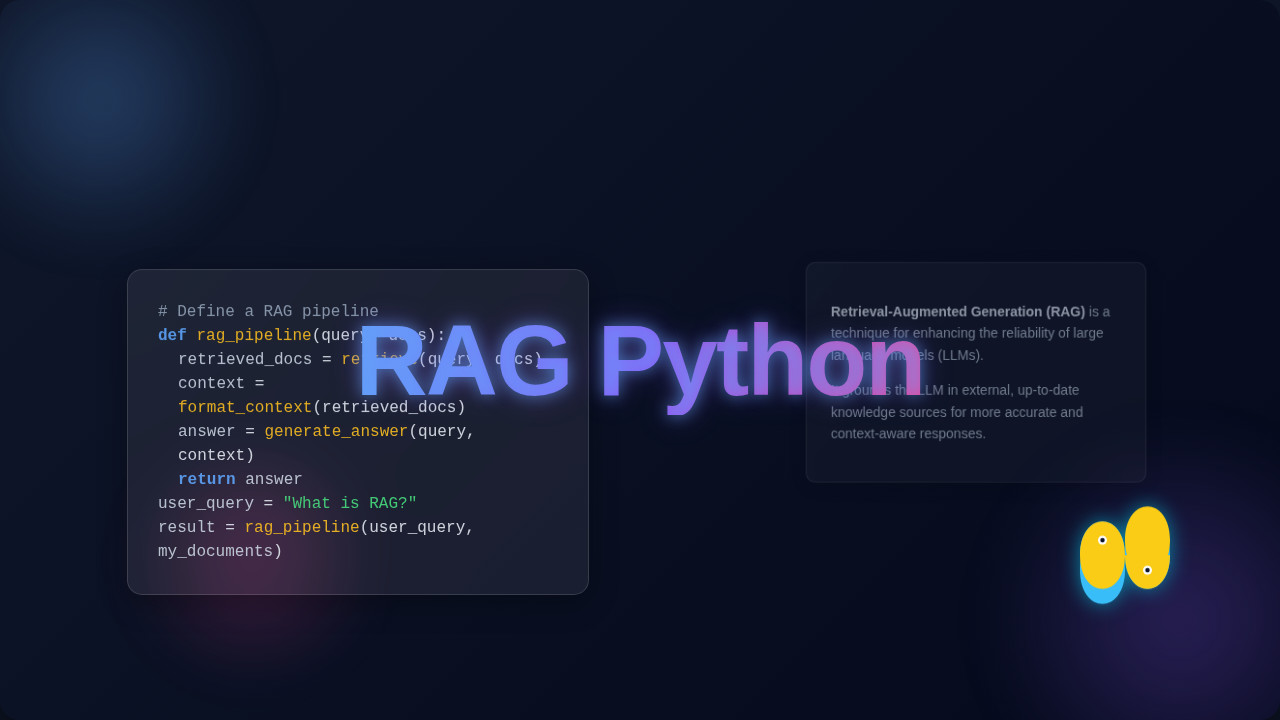
RAG Python Blog Thumbnail: Elite UI/UX Design & Code Visuals
Hello, future AI wizard! Ever feel like your brain is overflowing with new tech buzzwords? You know, the kind that sound super important, but trying to grasp them feels like deciphering ancient scrolls? Don’t worry, you are not alone!
Today, we are tackling one of those crucial terms: Retrieval Augmented Generation, or RAG. And more specifically, we will explore why RAG Python is becoming a superstar for building smarter, more reliable AI applications. You are about to see how it can totally transform your projects!
What Exactly is RAG Python?
Let’s cut straight to it. You have probably interacted with powerful Large Language Models (LLMs) like ChatGPT, right? They are incredible at generating text, but sometimes they can invent facts or give you outdated information. We call these ‘hallucinations,’ and they are a real headache when you need accurate answers.
Here’s where RAG steps in. Think of RAG as giving your LLM a super-smart research assistant. Before the LLM tries to answer your question, this assistant quickly finds the most relevant, up-to-date information from a trusted source. Then, it hands those notes directly to the LLM.
The LLM then uses your question PLUS those trusted notes to formulate its answer. This simple yet powerful combination of “Retrieval” (finding info) and “Generation” (creating text) makes your AI far more accurate and reliable. You are essentially grounding its responses in real data.
Why RAG Python Matters to YOU (and Your AI Apps!)
So, why should you care about RAG Python? Because it solves real problems you will face when building AI apps! Imagine creating an AI chatbot for a legal firm. You cannot have it making up laws, right? RAG ensures accuracy.
First, RAG significantly reduces those pesky hallucinations. Your AI is less likely to invent facts when it has a solid reference to work from. This means more trustworthy answers for your users. Second, it keeps your AI’s knowledge fresh. LLMs are trained on data up to a certain point. RAG lets you feed it new information constantly without retraining the entire model. That’s a huge time and resource saver for you!
Third, it allows your AI to answer questions about proprietary or very specific data. Want to build a private AI chatbot that understands your company’s internal documents? RAG is the way. You can even build a specialized private AI chatbot without sending your sensitive data to external models. This is huge for data privacy and security. Ultimately, RAG helps you build AI tools that users can genuinely rely on.
The RAG Python Playbook: How It Actually Works
Let’s peek behind the curtain. How does this magic actually happen? It is a well-orchestrated dance of a few distinct steps. You ask a question, and the RAG system swings into action.
Step 1: Your Query
This is where it all begins. You type your question, like “What were the Q3 sales figures for Project X?” or “Explain the new return policy.” This is your input to the RAG system.
Step 2: Retrieval (The “R”)
This is the research assistant at work. Your system takes your question and intelligently searches a predefined knowledge base. This could be a collection of documents, a database, or even a database specifically designed for finding specific data efficiently. It is not just keyword matching. Often, it uses “embeddings,” which are numerical representations of text that capture its meaning. This allows the system to find conceptually similar information, even if the exact words are not present. It then pulls out the most relevant snippets.
Step 3: Augmentation
The retrieved information does not just sit there. It is carefully integrated with your original question. This creates an “enhanced prompt” — your question, now enriched with highly relevant context. Think of it like a lawyer preparing a case, bringing together all the critical facts before presenting their argument.
Step 4: Generation (The “G”)
Finally, this enhanced prompt is sent to the LLM. The LLM then processes both your question and the provided context. It uses this combined knowledge to generate a precise, factual, and helpful answer. You just built a powerful web scraping Q&A system, all thanks to RAG!
Common RAG Python Confusions Cleared Up
It is easy to get a few things mixed up when learning new tech. Let’s clarify some common misunderstandings about RAG.
First, RAG is NOT about retraining your LLM. You are not fine-tuning the model itself. Instead, you are providing it with external knowledge at runtime. This is much faster and more cost-effective than constant retraining. Second, RAG is not a magic bullet. It still relies on the quality of your retrieved data. If your knowledge base is messy, outdated, or incomplete, RAG will only be as good as its inputs.
Pro Tip: Always prioritize the quality and organization of your knowledge base. Garbage in, garbage out still applies, even with the smartest AI!
Third, RAG is not just for chatbots. While chatbots are a popular use case, you can use RAG for summarizing documents based on specific criteria, generating reports grounded in live data, or even creating content with factual backing. The possibilities are vast when you learn to build reliable and accessible systems.
Key Takeaways for Your RAG Python Journey
You have made it this far, which means you are serious about building better AI applications! Let’s quickly recap what you have learned today about RAG Python and why it is a game-changer.
RAG empowers your AI with current, factual information, significantly boosting accuracy and trustworthiness. It allows you to build AI applications that truly understand and respond to specific domains without costly LLM retraining. You are making your AI smarter, more reliable, and much more useful in real-world scenarios. It is a powerful pattern that enhances existing LLMs, making them practical for a wider range of applications.
Beginner’s Wisdom: Start small with your RAG projects. Focus on a clear knowledge base and a simple question-answering task to build your confidence and understanding.
As you dive deeper into building sophisticated AI tools, remember the importance of strong foundational skills. Just like managing complex tasks in a user-friendly way, perhaps with a tool like a React Task Manager, structuring your RAG pipeline effectively is key to success.
Your Next Steps with RAG Python!
You now have a solid understanding of RAG and its potential. This is just the beginning of your journey. The best way to learn is by doing, right?
Start experimenting with simple RAG setups. There are many open-source libraries in Python that make it accessible for beginners like you. Play around with different knowledge bases and see how it impacts your AI’s responses. You are equipped with the knowledge to make your AI applications truly intelligent and trustworthy. Keep learning, keep building, and keep pushing the boundaries of what you can create!